
Crowns

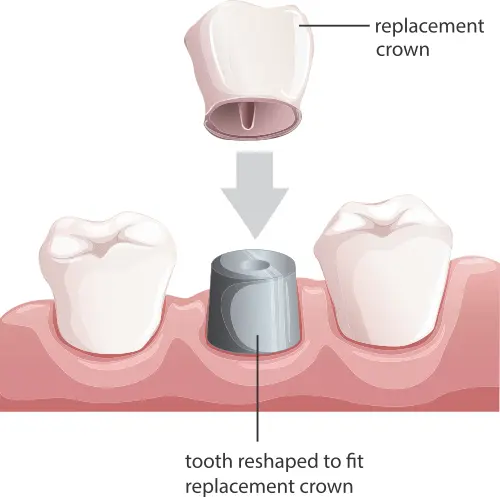
Crowns improve the strength, function and appearance of teeth when a more conservative approach will not suffice. Crowns, more commonly referred to as caps, can be placed over teeth that have lost their structure or are cracked. They can be applied to teeth that have previously been treated or filled. The protection offered by a crown can in many instances prevent complications resulting in more expensive treatments, or worse, the loss of a tooth. Naturally, our dentists will ensure your crowns provide the best aesthetic outcome for your smile.

Previously it would take two weeks for the permanent crown to be ready after preparing the tooth, however due to technological advances, we now offer single day dentistry! This is a new revolutionary approach that enables us to design, fabricate and fit a new crown in a single visit, a procedure that would normally take at least two weeks. The size, shape and colour are perfectly matched for the patient’s mouth, the crown is designed and fabricated to withstand everyday use.

Ask us if you think your smile can benefit from a crown by booking a consultation.
Same Day Crowns

Previously it would take two weeks for the permanent crown to be ready after preparing the tooth, however due to technological advances, we now offer single day dentistry! This is a new revolutionary approach that enables us to design, fabricate and fit a new crown in a single visit, a procedure that would normally take at least two weeks. The size, shape and colour are perfectly matched for the patient’s mouth, the crown is designed and fabricated to withstand everyday use.

Dental Crowns, Bridges and Veneers

Dental crowns, bridges, and veneers are transformative solutions for enhancing the appearance and function of your teeth. At Riccarton Dental Studio, we offer these restorative and cosmetic treatments to address a variety of dental concerns.

Dental crowns are custom-made caps that cover damaged or weakened teeth, restoring their strength and appearance.

Bridges are used to replace missing teeth by anchoring artificial teeth to adjacent natural teeth or dental implants.

Veneers are thin shells of porcelain or composite resin that are bonded to the front surface of teeth to improve their colour, shape, or size.

Whether you need to repair a damaged tooth, fill gaps in your smile, or enhance the aesthetics of your teeth, our skilled team can help you achieve the smile of your dreams with these versatile treatments.

Read more about our procedures below.

When trauma or disease caused the loss of a tooth in an aesthetics zone the effect on a person’s well-being can be more than psychological.

Teeth may shift and move adjacent to the space due to forces generated during chewing, grinding or clenching. Fortunately there are several options to replace the missing tooth; one option is a non-removable custom-made ceramic bridge that is held in place using the teeth on either side of the missing tooth.

Either side of the missing tooth are then prepared and an impression is taken of the prepared teeth and surrounding areas. A temporary bridge is put in place to replace the missing tooth. The tooth impression is then sent to a dental laboratory for custom fabrication and shading of the final bridge. The temporary bridge is removed and the underlying supporting teeth are cleaned and prepared with a bonding agent; resin cement is added to the inside of the bridge and placed onto the prepared teeth.

When a tooth in a heavy chewing area becomes worn, damaged , or has had a root canal, then a full-coverage gold crown may become the restoration of choice.

To prepare the tooth for a gold crown, the tooth must first be prepared. The preparation involves removing a minimum amount of tooth structure from all surfaces; the dentist will then take an impression of the tooth, typically using putty -like materials loaded into an impression tray.

After the impression is taken, a temporary crown will be fabricated out of an acrylic material to cover and protect the tooth. This will need to be worn for 1 to 2 weeks while the impression is sent to a dental laboratory for custom manufacturing of the gold crown.

When the finished permanent crown returns, the temporary crown is removed, and the new full gold crown is cemented onto your tooth. Gold is one of the most biocompatible materials for the mouth.

Porcelain crowns are an aesthetic solution used to restore discoloured, decayed or badly broken down teeth. In this case a root canal tooth that has been previously restored requires a crown.

To make a crown a small percentage of the tooth surface is removed and prepared to specific dimensions, then using putty -like material in a special tray a precise impression is taken of the prepared tooth. Finally a temporary crown will be made to cover the tooth; the impression tray is sent to the dental lab to fabricate a custom-made permanent porcelain crown. After 1 to 2 weeks the permanent crown is ready. The temporary crown is now removed and the new crown is permanently cemented onto the prepared tooth. The size, shape and colour are perfectly matched for the patient’s mouth, the crown is designed and fabricated to withstand everyday use.

Dental decay is one of the most common diseases in the world and if left unchecked can lead to extensive breakdown of the tooth and potential loss.

To prevent further decay of the tooth and restore that which has been destroyed your dentist may choose to place a bonded indirect restoration known as an inlay.

This procedure begins with removal of the decayed tooth structure; the dentist will also follow specific preparation guidelines to accommodate the inlay restoration.

An impression is then taken of the prepared tooth. Once the impression is completed a temporary filling is used to seal the inlay in place. The impression is then sent to a dental lab for custom fabrication of the inlay. The inlay may be fabricated of either composite material or ceramic; a choice that will depend on the location of the inlay. Upon return from the lab the temporary inlay is removed.

The tooth is then prepared with the cleaning agent and an adhesive agent that is used to bond the adhesive cement to the inlay. This cleaning agent is rinsed off and the adhesive bonding agent is applied. This adhesive is then cured with blue light so that it hardens. The blue light waves have energy required to polymerize the bonding agent.

Resin cement is then applied to the underside of the inlay and placed onto the tooth preparation. Excess cement is removed with a small brush. The curing light is then used to harden the cement and bond the inlay to the tooth.

Inlays are not only highly aesthetic and a good choice for larger restorations but also offer greater strength and hardness than regular fillings.

When chewing or grinding leads to pain in the back molars, a dentist may test for a condition known as CTS or cracked tooth syndrome. CTS generally involves a crack that extends beyond the outer layer of the tooth known as enamel and into the layer below called dentin. In extreme cases, it may even extend beyond the dentin and into the pulp chamber or periodontal structure around the roots.

The bite test is the definitive test for a cracked tooth; during this test, the patient is asked to bite on a testing device. The pain increases as the biting force increases, and relief occurs once the pressure is withdrawn. In some cases, there may only be painful symptoms after the force on the tooth has been released. Pressure applied to the crown of a cracked tooth leads to separation of the tooth components along the line of the crack. Such separation in the dentin layer below the enamel results in the stimulation of nerve endings. Direct stimulation of pulpal tissues occurs if the crack extends into the pulp.

Visual inspection of the tooth is useful, but cracks are not often visible without the aid of magnification; specialized techniques such as transillumination may further provide clear visual evidence of a cracked tooth.

When decay affects a highly aesthetic or viewable area of the mouth the benefits of bonded fillings make them a first choice to restore these areas. Once the decay has been removed the tooth is prepared and cleaned.

A bonding agent is then applied to the tooth.

The tooth structure material is then artistically matched to the existing tooth colour. The filling material is then placed and shaped to fill the tooth and hardened by the energy emitted from a special blue light source. Finally the tooth structure is shaped and polished to a lustrous finish to blend in with the existing tooth structure.

Frequently Asked Questions

What is a dental crown?

A dental crown is a custom-made restoration that completely covers a damaged or weakened tooth. It restores the tooth's shape, strength, function, and appearance while protecting it from further damage.

When is a dental crown recommended?

Your dentist may recommend a crown if a tooth is severely worn, cracked, broken, has a very large filling, has undergone root canal treatment, or needs additional protection to prevent future fracture.

How long do dental crowns last?

With good oral hygiene and regular dental check-ups, a dental crown can last 10–15 years or longer. Its lifespan depends on factors such as oral hygiene, diet, teeth grinding, and general wear.

Are dental crowns painful?

The procedure is carried out under local anaesthetic, so you should be comfortable throughout your appointment. Some mild sensitivity is normal after treatment but usually settles within a few days.

How do I care for my dental crown?

Care for your crown just as you would your natural teeth by brushing twice daily, flossing every day, and attending regular dental check-ups and professional cleans. Good oral hygiene helps protect the tooth underneath the crown and the surrounding gums.

Can a crowned tooth still get decay?

Yes. While the crown itself cannot decay, the natural tooth underneath can develop decay around the edge of the crown if plaque builds up. Maintaining excellent oral hygiene is essential.

Will my crown look like a natural tooth?

Yes. Modern ceramic crowns are carefully colour-matched to your surrounding teeth and designed to blend seamlessly with your smile.

Can I eat normally after getting a crown?

Once your permanent crown has been fitted and your dentist confirms your bite feels comfortable, you can eat as normal. Avoid chewing very hard objects such as ice or hard lollies, as these can damage both natural teeth and restorations.

What is the difference between a crown and a filling?

A filling repairs a portion of a damaged tooth, while a crown covers the entire visible part of the tooth. Crowns are generally recommended when there isn't enough healthy tooth remaining for a filling to provide long-term strength.

What is the difference between a crown and a veneer?

A crown covers the entire tooth and is used to restore strength and function, whereas a veneer covers only the front surface of the tooth and is primarily used to improve its appearance.

Is a same-day crown as durable as a traditional crown?

Yes. Same-day crowns are made from high-quality ceramic materials designed for strength, durability, and everyday function. Your dentist will determine whether a same-day crown is the best option for your individual case.

How do I know if I need a crown?

If you have a cracked tooth, a large filling, ongoing tooth pain, or a tooth that feels weak, a consultation with your dentist can determine whether a crown is the most suitable treatment.